JCB Hydromax breaks 400 mph to set FIA hydrogen land speed record
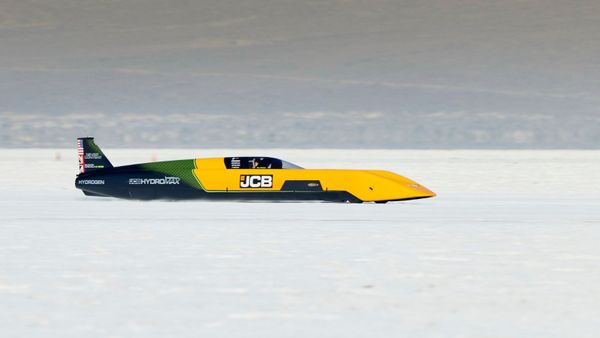
JCB says the Hydromax has averaged 406.320 mph across two FIA-timed runs at Bonneville with its full-power engine set, five days after hitting 368 mph at Speed Week on reduced output.

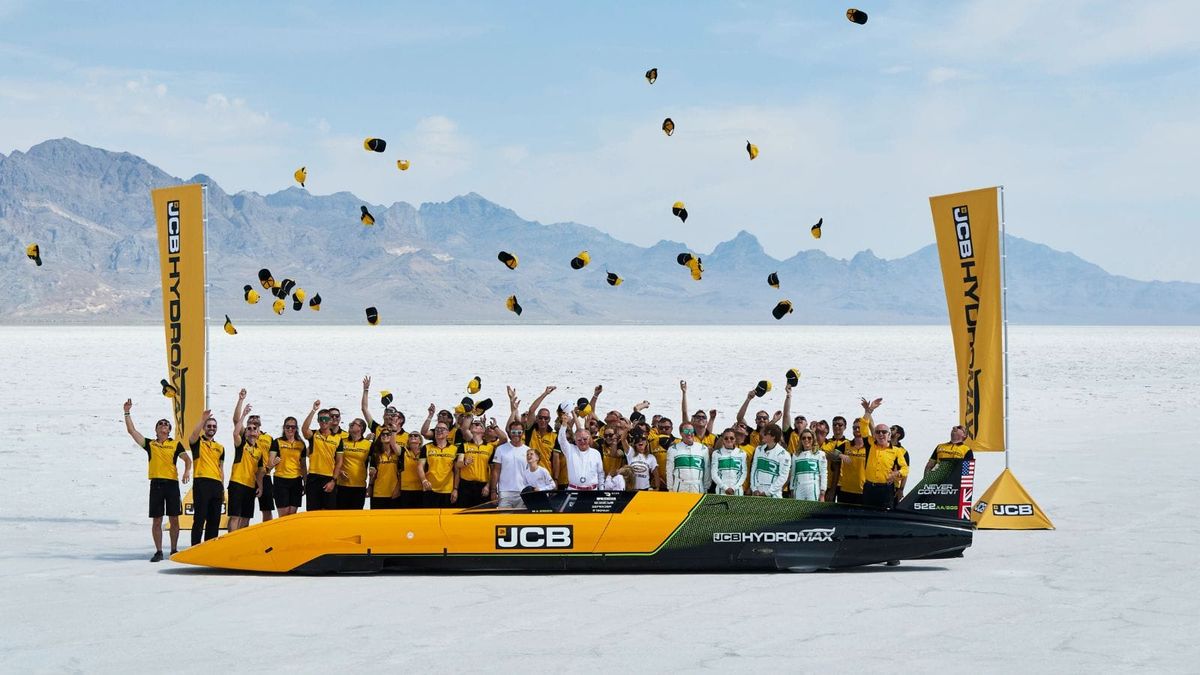
JCB, the British construction equipment manufacturer, says its hydrogen-powered Hydromax has set a world land speed record of 406.320 mph at the Bonneville Salt Flats, becoming the fastest hydrogen-powered vehicle of any kind in history. The 32-foot streamliner is powered by two hydrogen internal combustion engines - conventional engines modified to burn hydrogen instead of diesel - and the record is subject to official ratification by the FIA in Category A, Group XIV, Class 7.
Wing Commander Andy Green OBE, the fastest man on earth at 763.035 mph and the only person to have broken the sound barrier on land, recorded 400.623 mph on his first run today and 412.135 mph on his second, completing two runs in opposite directions within an hour under FIA rules. Five days ago, the same car set an SCTA class record of 368.347 mph at Bonneville Speed Week - but that run used the car's lower-powered engine set, capped at 600 bhp per unit. Today's FIA attempt used the full 800 bhp configuration, with both turbocharged 4-cylinder hydrogen engines running at their 50-bar direct injection ceiling for a combined 1,600 bhp.
From 368 to 406 in five days
The 38 mph jump from Speed Week came from roughly a third more power. The Bonneville salt course has been shrinking due to environmental degradation - Green had approximately 8 miles of usable surface today compared to the 11 miles available when he drove the JCB Dieselmax to the FIA world diesel land speed record of 350.092 mph on the same salt in August 2006. That diesel record still stands. Twenty years on, the company has beaten its own benchmark with zero tailpipe CO2.
"Bonneville is the spiritual home of the world land speed record, and JCB Hydromax has just written itself into that history," Green said. "The car was terrific - stable, strong and fast."
The speed comfortably beats the FIA hydrogen combustion benchmark of 185.5 mph set by the BMW H2R in 2004, and also exceeds the 303 mph hydrogen fuel cell mark set by Ohio State University's Buckeye Bullet 2 in 2009.
'The same engines powering JCB diggers right now'
The engines that hit 406 mph today are tuned versions of the same 74 bhp units now going into JCB's 3CX Hydrogen backhoe loader at the company's Foston factory in Derbyshire. JCB has invested more than £100 million in its hydrogen engine programme, and the 3CX received EU Stage V type-approval in 2025 across 10 European countries.
"This record was set by production-based engines, the same engines powering JCB diggers right now," JCB Chairman Lord Bamford said. "That is the point of JCB Hydromax - it shows hydrogen works, and it works today at the highest level with zero emissions."
FIA president Mohammed Ben Sulayem called the record "a truly historic milestone for motorsport" and said it showcased "the potential of hydrogen combustion for the future of sustainable mobility." The record comes ahead of the opening of JCB's new $500 million factory in San Antonio, Texas, employing 1,500 people. The Hydromax was developed with engineering support from Prodrive, Ricardo, Ryze Power, TAG Heuer and Defender.