Insight: JCB's hydrogen land speed record car hits the runway ahead of Bonneville bid
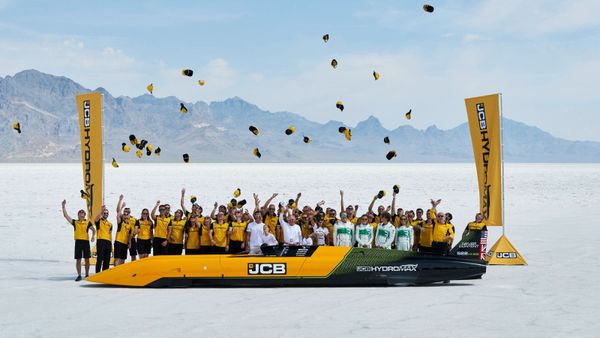
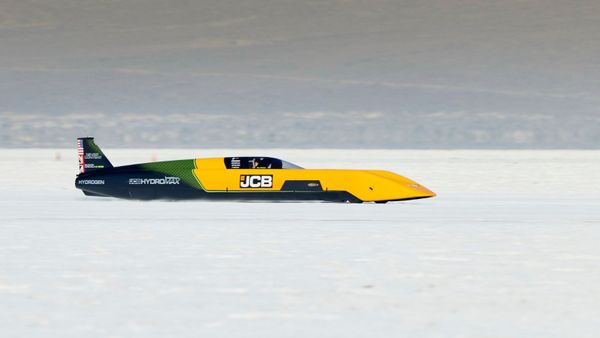
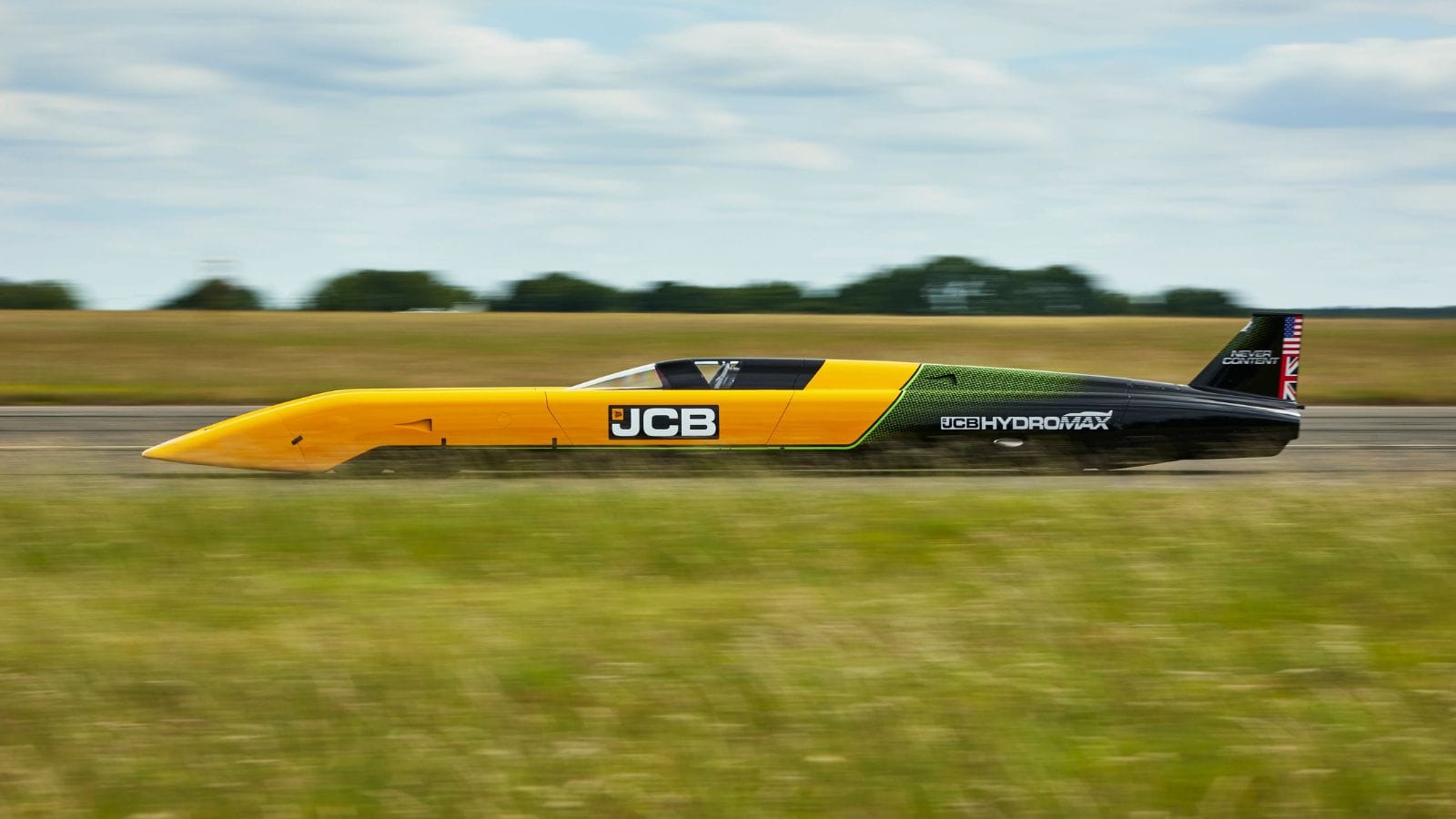
JCB says its hydrogen-powered land speed car has reached 177 mph during live testing at RAF Wittering, with Andy Green driving and both production-based hydrogen engines running under load for the first time ahead of a Bonneville record attempt in August.

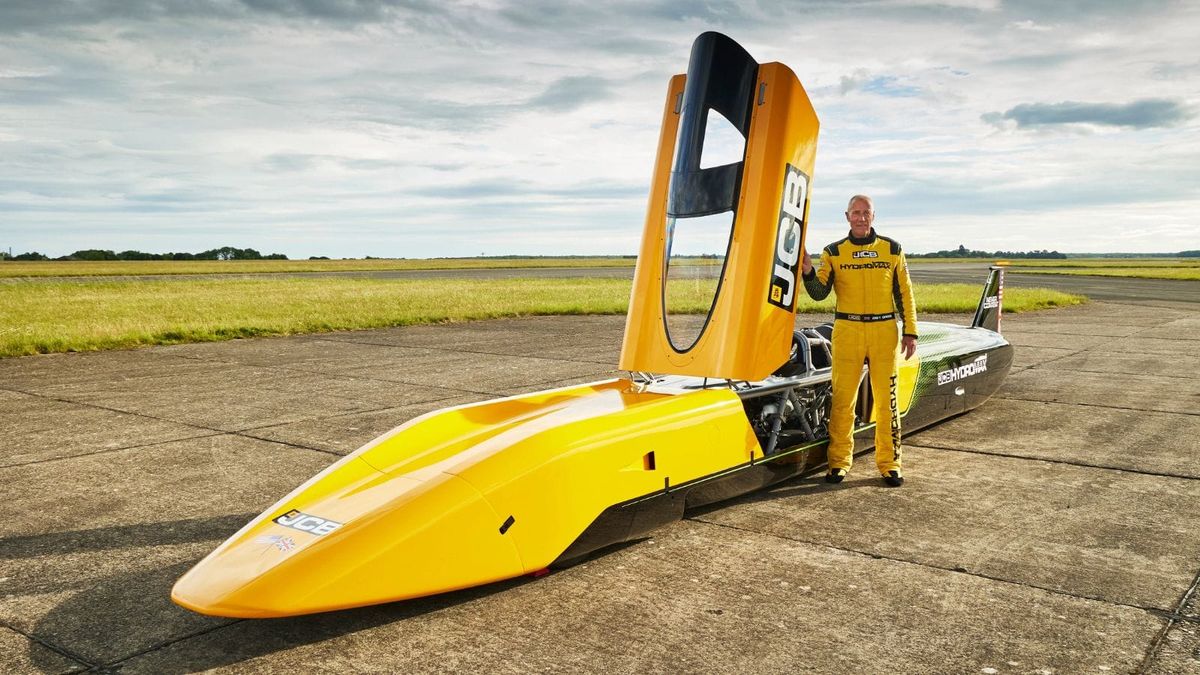
JCB, the world famous construction equipment manufacturer best known for its yellow diggers, confirmed its Hydromax hydrogen land speed car reached 177 mph during testing at RAF Wittering in Cambridgeshire this week.
Wing Commander Andy Green - the only person to have broken the sound barrier on land, and the driver who set JCB's existing diesel land speed record of 350.092 mph in 2006 - was at the wheel, with both of the car's hydrogen internal combustion engines running under full load for the first time.
The Hydromax is a 32-foot streamliner powered by 2 turbocharged hydrogen engines producing a combined 1,600 bhp, and JCB intends to use it to set the world hydrogen land speed record, sanctioned by the FIA - motorsport's global governing body - at the Bonneville Salt Flats in Utah this August.
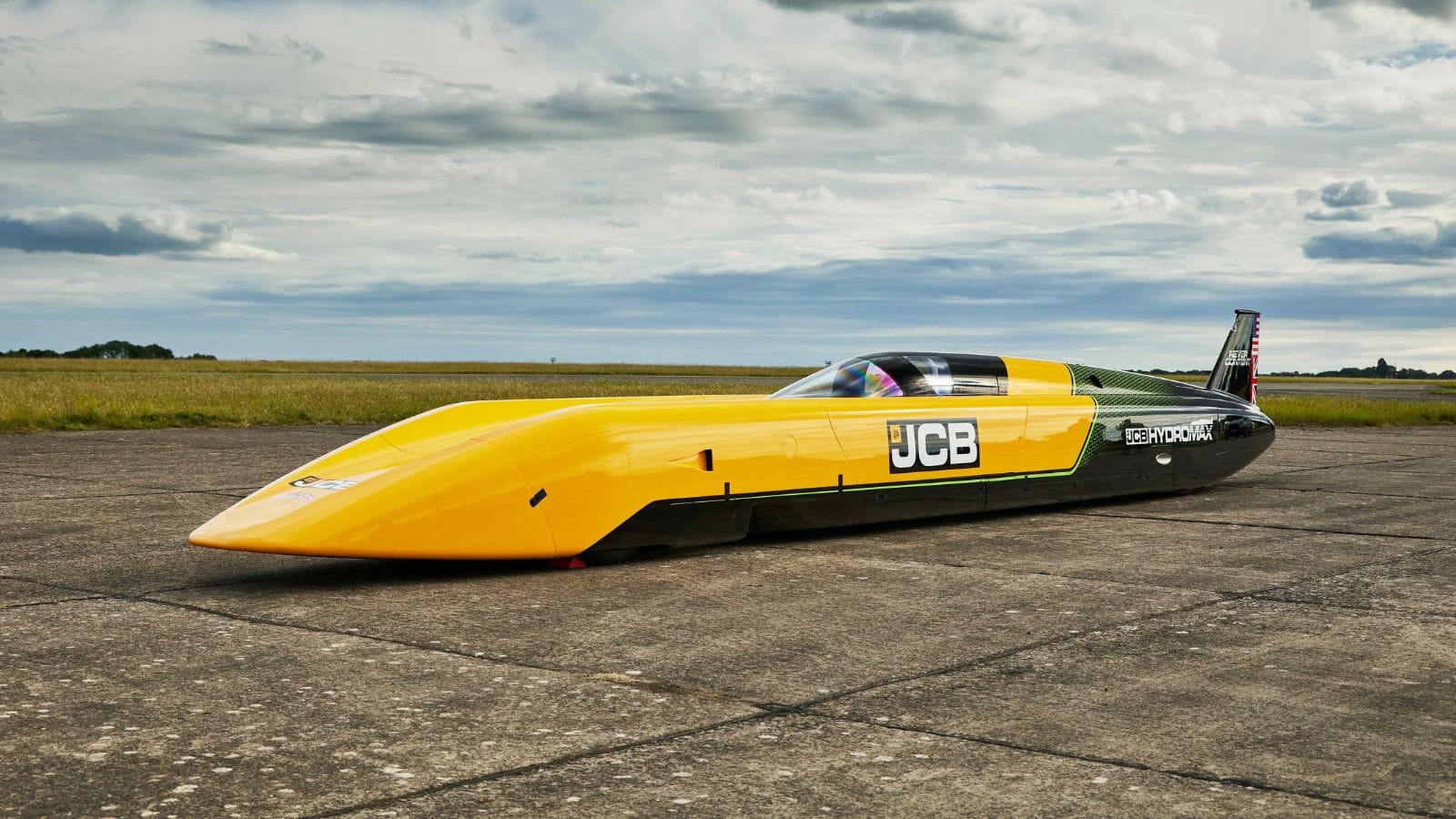
The car was unveiled at JCB's Rocester headquarters on 12 May as the centrepiece of a £100 million, 5-year programme to develop hydrogen combustion engines for the company's construction machinery. Those engines are already going into commercially available diggers and generators.
Ryan Ballard, JCB's engineering director and the project lead, told journalists at the RAF base that the team had completed several runs over the previous week, building speed incrementally while correlating live telemetry data against simulation models.
"Every run, every refuel and every tyre change we complete in the UK is one our team won't be doing for the first time on the Salt Flats," Ballard said.
Record setter Andy Green, speaking to press after the day's final run, said both engines were producing around 350 bhp each at 30 bar rail pressure - against the 800 bhp and 50 bar they will deliver at Bonneville.
The car ships to the US in early July, with SCTA Speed Week - the annual land speed racing event run by the Southern California Timing Association - scheduled for the first week of August and the FIA record attempt the week after.
"It's easy to get a hydrogen engine to run - it's difficult to get it to run well"
A hydrogen internal combustion engine works on the same principle as a conventional petrol or diesel engine - fuel is burned inside cylinders to drive pistons - but uses hydrogen gas instead of fossil fuel.
Because hydrogen contains no carbon, the exhaust is water vapour rather than CO2. JCB's engines use spark ignition, like a petrol engine, rather than the compression ignition of a diesel, and inject hydrogen gas into the intake at relatively low pressure before igniting it with a spark plug.
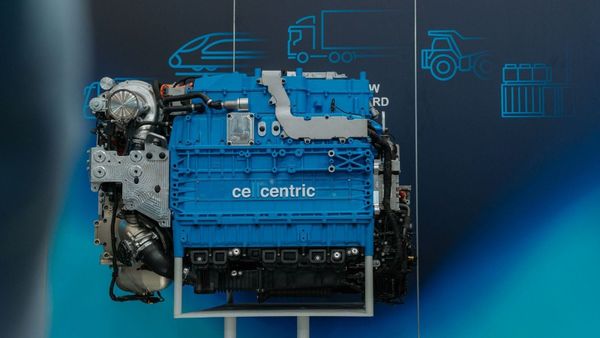
Each of the Hydromax's 2 race engines traces its lineage to the 74 bhp hydrogen unit that JCB builds on the same production line as its diesel engines at Dove Valley Park in Derby, using the same crankshaft that goes into the company's commercial 448 diesel and hydrogen engines.
Mark Richards, a principal engineer at JCB Power Systems who presented the engine session at Wittering, summarised the challenge the team had found when reviewing 2 decades of prior hydrogen combustion research. "It's very easy to get a hydrogen engine to run," he said. "It's difficult to get it to run well."
Getting to 800 bhp per unit from a 74 bhp production base meant reworking the top end and fuelling architecture while keeping the base block in cast iron.
JCB switched from port fuel injection at 10 bar to direct injection at 50 bar, spun the engine from 2,200 rpm to 3,800 rpm, and replaced the pushrod valvetrain with double overhead cams to handle the higher speeds. A 3D-printed charge cooler sits between the turbocharger outlet and the intake manifold, dropping intake air from around 200°C to below 10°C in only 5 inches using ice water from the car's cooling tanks.
Each engine has shed nearly 100 kg through aluminium and alloy components and a titanium turbo compressor spinning at over 150,000 rpm, and both run dry sump lubrication pumping a litre of oil per second to cope with being mounted at 90 degrees to keep the centre of gravity low.
The crankshaft, the block architecture, and the lean-burn combustion strategy all carry through from the production engine. What changes is the fuelling, the breathing, and the rotating mass - optimised for a 4 kg fuel load burned over a matter of minutes rather than a working day in a quarry.
"We typed into Google hydrogen engines and it told us all the reasons not to do it"
JCB's hydrogen engine programme began in the summer of 2020, after the company had already built and tested a hydrogen fuel cell excavator.
Fuel cells generate electricity from hydrogen through a chemical reaction rather than combustion, and are widely used in hydrogen cars, buses and trucks. But JCB's experience with them on construction sites was poor.
Tom Beamish, JCB's advanced projects deployment manager, told Hymotive that the engineering team sat down with Lord Bamford, JCB's chairman, on 20 July 2020 and laid out what they had learned.
Electric machines worked for compact equipment with access to grid power. Fuel cells offered the portability of hydrogen but brought problems the construction industry could not live with. "The most technologically advanced machine we've ever built - also the most expensive, most complicated, and the least robust," Beamish said. Fuel cells on building sites were poisoned by diesel fumes from neighbouring generators, required non-conductive coolant at £56 a litre - a burst pipe in the field would write off a £100,000 [fuel cell] stack - and could not cope with the violent load spikes of an excavator hitting a pile of earth at full hydraulic force.
Bamford told the engineers to build a hydrogen engine instead. "We typed into Google hydrogen engines and it told us all the reasons why they were a bad idea," Beamish said. Previous early attempts by other manufacturers, including BMW, had used naturally aspirated engines running hydrogen at high temperatures, producing NOx emissions that undermined the zero-emission case.
JCB's approach inverts that with lean burn, low-temperature combustion and powerful turbocharging - large volumes of air, small quantities of hydrogen, cool enough to fix the emissions problem inside the cylinder rather than in the exhaust.
JCB says the result is an engine that meets European Stage 5 emissions standards without any aftertreatment system - no particulate filter, no selective catalytic reduction, no AdBlue.
Beamish said it achieves approximately 40% brake thermal efficiency at certain operating points, fractionally above the 39% of JCB's equivalent diesel. The company says it has completed over 50,000 hours of testing and built more than 200 hydrogen engines down its production lines since that first unit ran in December 2020.
Two records and a shrinking course
Two existing hydrogen speed records stand between the Hydromax and the mark JCB wants.
The overall hydrogen land speed record stands at 303 mph, set in 2009 by Ohio State University's fuel cell-powered Venturi Buckeye Bullet 2. The hydrogen internal combustion engine record is 187.62 mph, set by BMW's H2R at the Miramas proving ground in France in 2004 using a 6-litre V12 producing 285 bhp.
The Hydromax, at 1,600 bhp, has already passed 177 mph on a Cambridgeshire runway with weeks of development ahead. JCB's stated target, though, is not either of those hydrogen records - it is the company's own DieselMax diesel mark of 350.092 mph.
Lee Harper, JCB's chief engineer on the project, told journalists at Wittering that the Bonneville salt course has been shrinking over the years due to changing environmental conditions. DieselMax had 11 miles of course in 2006, but last year the usable length was around 8 miles. "It's more likely to be Mother Nature that sets against us than the tyres," Harper said - a reference to the 2006 car, which was tyre-limited at its top speed.
The team won't know the course length until mid-to-late July, and Harper said they had designed the car around the minimum observed last year, treating anything longer as opportunity rather than expectation.
Green confirmed that the car carries 2 sets of engines. The current pair, running at Wittering, will be used at Speed Week capped at around 600 bhp. A second set, rated to the full 800 bhp per unit, goes in for the FIA record week. Green pointed to Burt Munro, the New Zealand motorcyclist whose Bonneville story became the film The World's Fastest Indian. Munro took 9 visits to set his record. "That's about average," Green said. "JCB's trying to do it in 10 days."
Ben Watson, JCB's industrial design director, explained that the car's aerodynamic development had benefited from 20 years of toolchain improvement. What took a week per iteration in 2006 now happens nightly or multiple times per night, delivering a 10% improvement in overall aerodynamic efficiency according to JCB's CFD modelling.
NACA ducts - a standardised air intake shape developed by NASA's predecessor agency - replace the original car's snorkel and nose hole, accounting for around 4% of the drag reduction alone. Ice cooling replaces radiators entirely, with up to 250 kg of ice loaded per run at Bonneville, sized to melt completely as the car crosses the finish line. The Hydromax is 560 mm longer than DieselMax at 10 metres and 10% lighter at roughly 2.5 tonnes.
The same engines, on building sites now
Commercially available hydrogen machines are already leaving JCB's production lines. The company sells a G60 RSH hydrogen generator and a 3CX hydrogen backhoe loader - the classic JCB silhouette - both built on the same lines as their diesel equivalents at Rocester in Staffordshire.
Cameron Scott, a senior JCB engineer, demonstrated the 3CX's refuelling system at Wittering. The backhoe carries 9 kg of compressed hydrogen at 350 bar in 3 aluminium and carbon fibre roof tanks and refuels in 10 to 15 minutes from a mobile unit. "It's a one-button operation," Scott said. "Hit go. That's it." Customers who have trialled the machine told JCB they could not tell it apart from the diesel version.
Beamish gave Hymotive a cost comparison across JCB's powertrain options. Battery electric machines cost roughly double their diesel equivalents because of the battery systems. JCB's fuel cell prototype was tracking toward 4 times. The hydrogen engine machine sits at around 50% more in the short term, with the premium driven largely by low-volume hydrogen tank supply chains, and Beamish said JCB expects the engine itself to reach cost parity with diesel over time.
JCB builds 350 product models across 16 product groups on a 7-year refresh cycle, putting 50 new machines on assembly lines every year - and the hydrogen engine slots into that existing manufacturing infrastructure without dedicated tooling or new production lines.
Hydrogen supply on construction sites follows the same logic as diesel today. JCB's partnership with HyKit, a startup developing mobile hydrogen refuelling units, provides what is essentially a hydrogen bowser - towed to site, left there for the week, swapped out when empty. No fixed station, and no grid connection required. At Wittering, the Hydromax itself was refuelled between runs from a mobile unit operated by Ryze Hydrogen, the same approach that will be used at Bonneville.
The £100 million hydrogen programme has already produced commercially available machines and a certified engine meeting European emissions standards without aftertreatment.
Whether the Hydromax breaks the land speed record in August depends on the salt, the weather, and 6 weeks of remaining development. Jamais content - never content - reads the Bamford family motto, printed across the car's bodywork and the crew uniforms at Wittering. At 177 mph and climbing, the car and its digger-derived engines are running.