California orders world's largest hydrogen bus station for 175-vehicle fleet
SamTrans has contracted FASTECH and Bosch Rexroth to build a station capable of dispensing 3.5 tonnes of hydrogen per day, featuring the first commercial deployment of Bosch Rexroth's CryoPump technology.

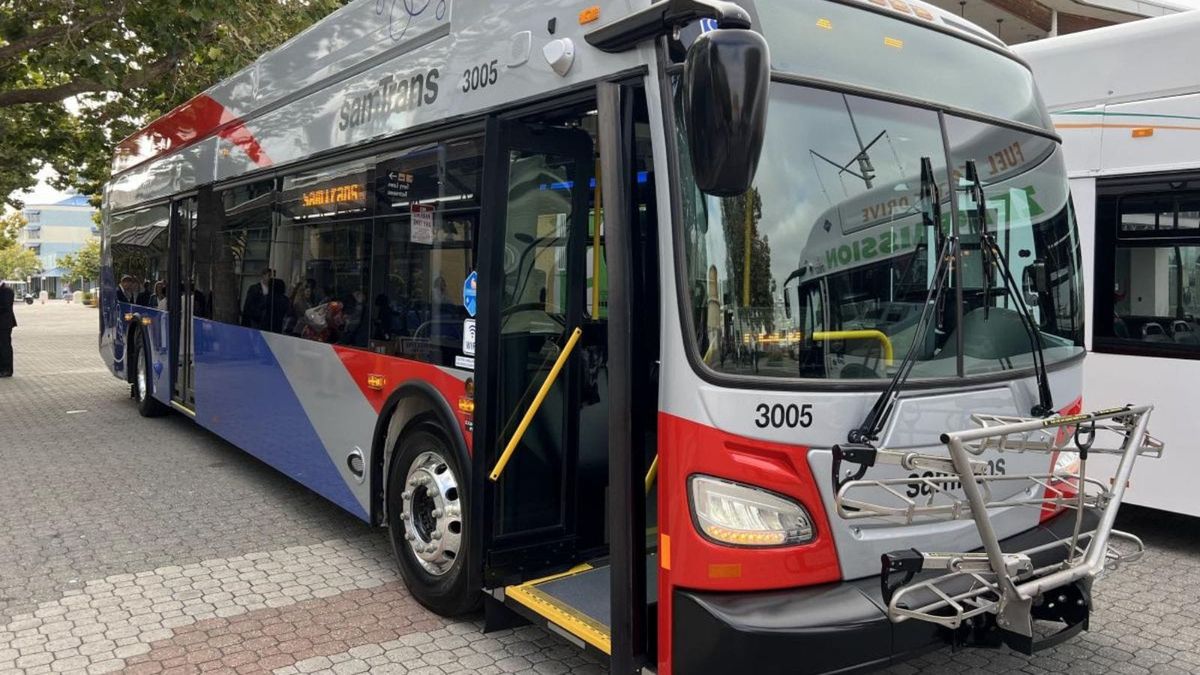
San Mateo County Transit District, the California public transport operator known as SamTrans, has contracted FASTECH and Bosch Rexroth to build what the two firms say will be the world's largest hydrogen refuelling station designed specifically for transit buses. The facility will serve a fleet of up to 175 fuel cell electric buses, dispensing up to 3.5 tonnes of hydrogen per day through 4 simultaneous dispensers.
Most hydrogen stations are substantially smaller. Analyst firm Interact Analysis found in early 2025 that nearly three quarters of the roughly 1,160 stations then operating worldwide dispensed no more than 500 kg per day. Larger facilities exist - China's Xuanli station in Xinjiang can handle 10 tonnes daily - but those serve heavy-duty trucking rather than urban transit fleets.
Bosch Rexroth's CryoPump makes its commercial debut
The SamTrans station will feature what FASTECH describes as the first commercial deployment of Bosch Rexroth's CryoPump, a liquid hydrogen pumping system first exhibited at Hannover Messe in 2024 and developed in collaboration with FirstElement Fuel, the largest commercial hydrogen station operator in the US. The technology uses a two-stage electro-hydraulic pump that handles both liquid and gaseous hydrogen, eliminating the buffer gas storage tanks and complex valve manifolding that have historically driven up the cost and physical footprint of large-scale hydrogen stations.
Bosch Rexroth says the CryoPump achieves efficiency above 95% and extends maintenance intervals beyond 4,000 hours - roughly 4 times the conventional benchmark for crankshaft-based pumps, according to the company. The system can dispense up to 1,200 kg of hydrogen per hour, and at less than 11 square metres requires a fraction of the space of a conventional high-throughput compression setup. It also nearly eliminates the hydrogen losses from boiloff and venting during liquid-to-compressed transfer, which have been a persistent source of waste at stations handling cryogenic hydrogen. Bosch Rexroth claims the technology cuts station operating costs by up to 70%.
The Center for Transportation and the Environment, a nonprofit focused on clean transport technologies, is providing third-party technical assessment for the project.
Not SamTrans' only hydrogen station
The FASTECH contract is the second major station project SamTrans has commissioned in recent months. In mid-2025, the agency awarded Trillium a $17.4 million contract to design and build a permanent hydrogen station at its North Base Facility in South San Francisco, expected to be operational by summer 2027. SamTrans has been running its initial hydrogen buses from an interim fuelling setup that lacks the capacity for the fleet now on order.
That fleet is already large and growing. In October 2024, SamTrans placed what was then the largest single fuel cell bus order in New Flyer's history - 108 Xcelsior CHARGE FC 40-foot buses valued at up to $168.25 million. The first 10 entered service in early 2025, with the remainder arriving in phases through early 2027. SamTrans says the hydrogen buses achieve roughly 300 miles of daily range, compared with around 200 for battery-electric alternatives - a gap the agency has cited as a deciding factor given the topography and route lengths across San Mateo County.
ARCHES funding and California's 2034 target
The infrastructure buildout is backed in part by $34.5 million from ARCHES, the Alliance for Renewable Clean Hydrogen Energy Systems - California's regional hydrogen hub, which became the first of 7 nationwide hubs to sign its agreement with the US Department of Energy. The broader ARCHES programme is underpinned by a $12.6 billion deal with the DOE, including up to $1.2 billion in federal funding and $11.4 billion in public and private matching investment.
SamTrans, which serves more than 10 million riders annually across 74 fixed routes, says it aims to eliminate diesel entirely by 2034 - 6 years ahead of the California Air Resources Board's Innovative Clean Transit mandate requiring all transit agencies in the state to run fully zero-emission fleets by 2040.