H2Accelerate tells EU to hold hydrogen targets as 10 nations push back
The hydrogen trucking collaboration says maintaining AFIR's mandatory infrastructure targets is essential for investor confidence, pointing to Germany's oversubscribed €220M scheme as evidence the regulation drives real demand.

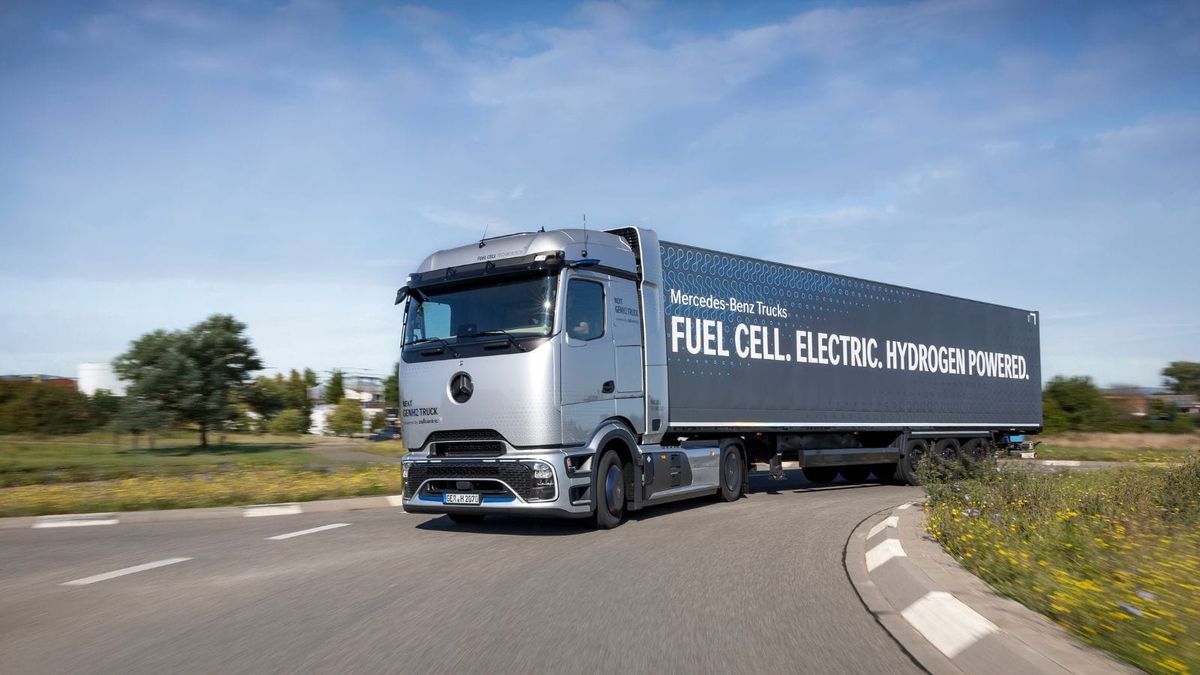
The H2Accelerate collaboration - whose members include Daimler Truck, Volvo Group, Hyundai Hydrogen Mobility, TotalEnergies, Linde, and TEAL Mobility - has published a position statement calling on the European Commission to maintain mandatory hydrogen refuelling station targets in the upcoming review of the Alternative Fuel Infrastructure Regulation, or AFIR. The regulation requires EU Member States to deploy hydrogen refuelling stations every 200 km along the TEN-T core road network - the EU's trans-European transport corridors - and in every urban node by the end of 2030.
In November 2025, 10 EU Member States - Estonia, Bulgaria, the Czech Republic, Finland, Hungary, Italy, Latvia, Poland, Romania, and Slovakia - signed a joint declaration calling for the relaxation of AFIR's infrastructure requirements, particularly for heavy-duty vehicles. That declaration was communicated to other Member States at the Transport Council in December 2025, and the Commission opened its formal call for evidence on the AFIR review on 23 March 2026. H2Accelerate's position statement is a direct counter to that push.
Any reduction in ambition, the collaboration says, "risks sending a negative market signal, stalling investment, increasing costs for early movers, and jeopardising Europe's road freight decarbonisation pathway."
Where the funding exists, industry has responded
The collaboration's strongest evidence comes from two Member States that have gone beyond targets and put money behind them. Germany launched a €220 million combined hydrogen station and truck subsidy in January 2026, modelled on the Netherlands' SWiM programme and designed to tackle the chicken-and-egg problem by requiring applicants to bundle station construction with vehicle purchases. By the deadline, the scheme had attracted 526 applications requesting €455 million - more than double the available budget.
Of those, 71 were for hydrogen refuelling stations and 455 for vehicles or vehicle fleets. The scheme targets up to 40 public hydrogen stations and around 400 trucks, with funding covering up to 50% of capital expenditure for stations and up to 80% of the additional cost of a hydrogen truck versus a diesel equivalent. Selection results are expected in the second half of 2026.
The Netherlands' SWiM (Subsidy for Hydrogen in Mobility) programme, which inspired the German scheme, has awarded €40 million to eight strategic partnerships - funding four new hydrogen stations, upgrades to four existing stations, and subsidies for 355 hydrogen vehicles, largely heavy goods vehicles with some buses. The Dutch government broadened the programme for 2026 to include mobile hydrogen storage and hydrogen-powered logistics machinery.
The 10 countries pushing for weaker targets are largely those that have not implemented equivalent schemes.
'Not yet on track'
The collaboration acknowledges in its statement that "progress at a pan-European level is not yet on track." Europe had roughly 294 operational hydrogen refuelling stations at the end of 2024, with Germany accounting for more than a third. AFIR requires a station every 200 km along the TEN-T core network, plus coverage in every urban node - a gap that current deployment rates will not close without significant acceleration.
H2Accelerate is not asking for the regulation to remain exactly as written, however. It calls for "targeted adaptations" to Article 6 - the section governing hydrogen station requirements - to better align minimum specifications with the operational needs of heavy-duty trucking. The collaboration says those adaptations were identified by the European Commission's Sustainable Transport Forum Hydrogen Sub-Group in 2025, though the specific recommendations have not been widely published.
"AFIR is a cornerstone policy for the development of Europe's zero-emission trucking ecosystem," said Hannah Bryson-Jones, spokesperson for H2Accelerate. "With the right policy framework in place, Europe can build a reliable, interoperable refuelling network and remain on track towards a competitive, decarbonised road freight system."
Who is H2Accelerate
The collaboration has evolved since Daimler Truck, IVECO, OMV, Shell, and Volvo Group founded it in December 2020. Shell, Iveco Group, and OMV have since departed. Hyundai Hydrogen Mobility, TotalEnergies, and TEAL Mobility - the Air Liquide and TotalEnergies joint venture planning more than 100 heavy-duty hydrogen stations on European corridors - have joined.
The separately funded H2Accelerate TRUCKS project, backed by €111 million from the EU's Clean Hydrogen Partnership, aims to deploy 125 fuel cell trucks across six EU countries, with the first vehicles expected to enter operation during 2026.
The Commission's AFIR review is due before the end of 2026. In November 2025, the EU awarded €600 million in grants across 70 projects under AFIR's infrastructure programme, including funding for 38 hydrogen refuelling stations for cars, trucks, and buses.