Sweden's first hydrogen truck corridor opens with Hydri's 10th station
Swedish infrastructure company Hydri has opened its 10th hydrogen refuelling station at Nyköpingsbro, completing what the company describes as the country's first connected network for heavy trucks along its busiest freight routes.

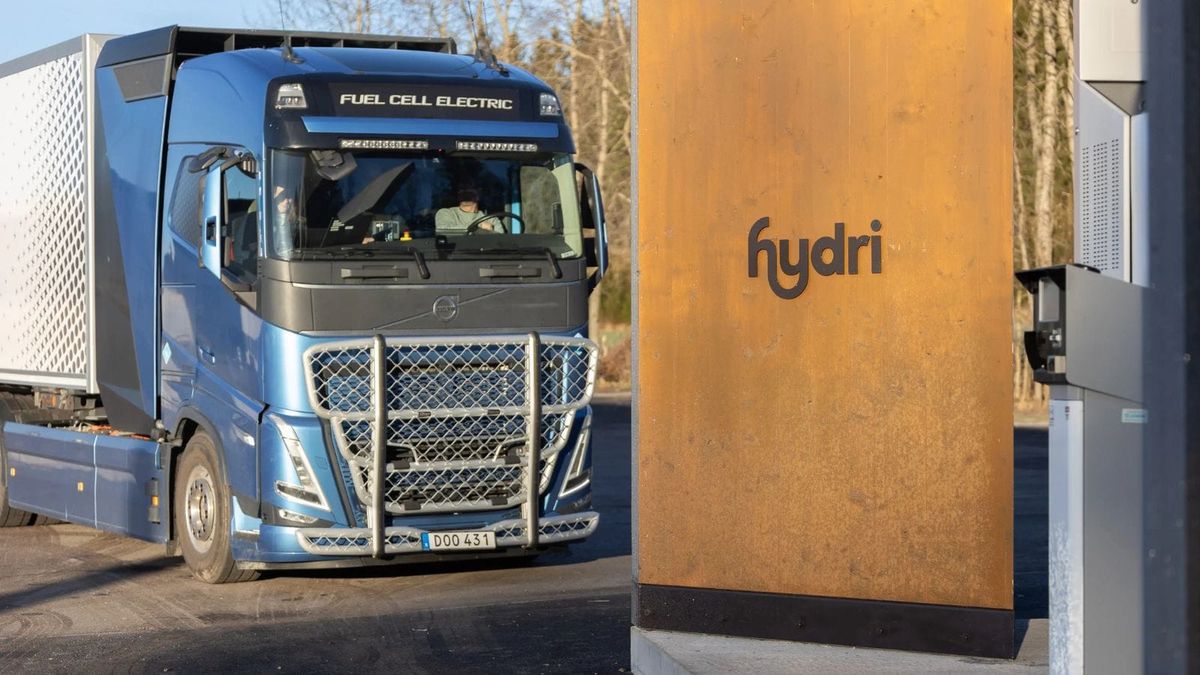
Hydri, the Swedish hydrogen refuelling operator backed by investment firm Qarlbo Energy, has opened the tenth station in what it calls the country's first connected hydrogen network, switching on the Nyköpingsbro site on 19 May. The chain of sites covers Skåne in the south, the west coast and the Stockholm region along the country's busiest road freight routes - enough, the company says, for hydrogen trucks to start running commercial routes the length of southern Sweden.
The Nyköpingsbro inauguration was attended by Rickard Nordin, energy spokesperson for the Centre Party, and Nyköping's mayor Urban Granström, alongside representatives from Volvo, Scania and Sweden's Environmental Protection Agency. Both manufacturers brought hydrogen trucks for live refuelling demonstrations.
Ten stations now, 24 more required by 2030
The current network runs through Göteborg port, Götene, Hallandsåsen, Håby, Karlstad, Mariestad, Nykvarn, Nyköpingsbro, Värnamo and Ödeshög. Most of the stations are co-located at sites operated by Rasta, Sweden's largest truck stop chain, which sees around 15,000 heavy vehicles a day across its network. Hydri says two more stations will come online during 2026, with a further eight by 2028, and the long-term ambition is a corridor running from Trelleborg in the south to Kiruna deep above the Arctic Circle.
That timetable sits against the EU's Alternative Fuels Infrastructure Regulation, which obliges every member state to build out a connected hydrogen network along the TEN-T core road corridors and at urban nodes by the end of 2030. Each station must dispense at least 1,000 kg of hydrogen a day at 700 bar. In Sweden's case, the mandate translates to 34 stations from north to south, which means Hydri's announcement covers somewhere short of a third of the required build with four and a half years to deliver the rest.
How Sweden's network compares to Europe
Sweden was a comparatively late starter on hydrogen infrastructure. As of the end of 2024 the country had six stations in operation, against Germany's 113, France's 65 and the Netherlands' 25 - a gap that reflected both lower population density and a particularly aggressive Swedish push on battery-electric trucks. Hydri's argument is that the two technologies are not in opposition. Where Sweden's grid capacity cannot yet support rapid charging for heavy fleets - which is much of the country, particularly in the north - hydrogen offers a fossil-free alternative that doesn't require operators to redesign their duty cycles.
Hydri chief executive Kamilla Björkman framed the case in operational terms. "In many places the grid capacity for fast-charging trucks doesn't exist, but with hydrogen the hauliers can choose a fossil-free alternative without it affecting their operations," she said.
Volvo and Scania are catching up
The infrastructure is opening more or less in step with the trucks. Scania is running fuel cell tractors under its Pilot Partner programme with logistics customers in Norway and Switzerland, using a twin 150 kW fuel cell stack delivering 300 kW combined, and is one of the brands signed up to deploy 125 hydrogen trucks across Europe through the H2Accelerate consortium, with first vehicles entering service during 2026.
Volvo Group has split its hydrogen approach in two. Its fuel cell trucks are aimed at long-haul applications, while in parallel it is testing hydrogen internal combustion engines - using Westport's HPDI direct injection technology - with fleet customers in 2026 ahead of a series production launch planned before 2030.
For now, Sweden's hydrogen vehicle fleet remains tiny, and Hydri makes no claim that opening ten stations creates instant demand. Instead, it gives hauliers a corridor they can plan around.
Where the network goes next
Trucks account for around a third of road transport's climate impact in Sweden, and the country has set itself among the more aggressive net-zero road freight targets in the EU. The AFIR deadline forces 34 stations by 2030; Hydri has ten in operation and another ten funded and in the pipeline by 2028. That puts the Swedish network on course to meet the EU requirement well ahead of most other member states, including some that started earlier and currently have more stations on the ground.
The trucks themselves are the more open question. Volvo and Scania's pilots are real but still small, and the H2Accelerate target of 125 fuel cell trucks across all of Europe is modest set against any meaningful share of the heavy-duty market. Hydri's stations are designed for 700-bar passenger refuelling as well as heavy-duty, which gives the network a fallback if commercial uptake runs slower than the regulation envisages.